Editors’ note: This post is part of a series featuring analysis of the 2025 International Court of Justice advisory opinion on obligations of Israel in and in relation to the Occupied Palestinian Territory. The introductory post to the series by Sean Watts is available here.
In its 2025 Advisory Opinion on Obligations of Israel in Relation to the Presence and Activities of the United Nations, Other International Organizations and Third States in and in Relation to the Occupied Palestinian Territory (2025 Opinion), the International Court of Justice (ICJ) identified the relevant obligations applicable to Israel in and in relation to the entire Occupied Palestinian Territory (OPT). However, the 2025 Opinion pays particular attention to the Gaza Strip.
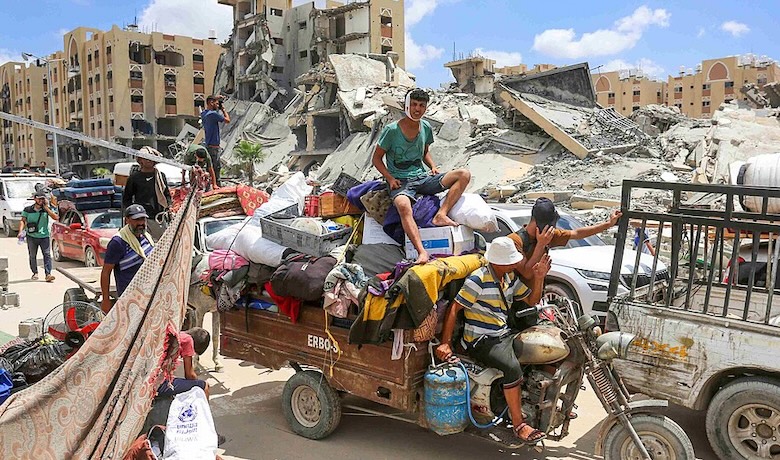
Firstly, unlike its Advisory Opinion on Legal Consequences Arising from the Policies and Practices of Israel in the Occupied Palestinian Territory, Including East Jerusalem (2024 OPT Opinion), which mainly focused on Israel’s conduct in the West Bank and East Jerusalem, most of the factual background against which the Court examined Israel’s obligations in the 2025 Opinion concerns Israel’s conduct in relation to the Gaza Strip. In particular, the Court addressed impediments to the delivery of humanitarian assistance (notably that provided by UNRWA) and military attacks (including those against UNRWA premises and personnel). This was not surprising, because the UN General Assembly requested the opinion in reaction to two Israeli laws, one of which called for the cessation of UNRWA’s activities in the OPT on the grounds that Hamas had infiltrated this United Nations agency in the Gaza Strip. UNRWA’s activities have proved critical for the inhabitants of the Gaza Strip territory since the attacks of 7 October.
Secondly, when considering Israel’s obligations under international humanitarian law (IHL), the Court devoted specific attention to Israel’s legal status in the Gaza Strip. It expressly qualified Israel as an occupying power in that territory, which implicitly means that the Gaza Strip was considered as an occupied territory – even though the Court did not specifically mentioned this. Consequently, the obligations the Court identified as binding on an occupying power apply to the Gaza Strip as well as to East Jerusalem and the West Bank (see especially the operative paragraphs of the 2025 Opinion.
This post examines Israel’s status as an occupying power in the Gaza Strip in relation to all the obligations identified by the Court. These include not only Israel’s obligations arising under IHL and international human rights law (IHRL), but also those stemming from its status as a member of the United Nations. On the one hand, it highlights the critical role this qualification played in the Court’s reasoning when identifying all these Israeli obligations. On the other hand, it questions the usefulness of such qualification, especially in light of the degree-of-control-based approach adopted by the Court in determining Israel’s IHL obligations, as well as its failure to follow that same approach when identifying the State’s other obligations.
Israel’s IHL Obligations as an Occupying Power
Considering Israel’s obligations as an occupying power, the Court first focused on those arising under IHL. Most of the facts referred to by the Court concerned Israeli impediments to the delivery of humanitarian assistance to the Gazan population, including its second total blockade of the Gaza Strip between March and May 2025. Accordingly, the Court mainly examined Israel’s IHL obligations in relation to humanitarian relief (paras. 91-133).
It was crucial for the Court to determine whether Israel was bound by the law of occupation in this regard, because the obligations under that body of law are far more demanding than those applicable in non-international armed conflicts or in international armed conflicts other than occupations. These obligations include, in particular, the unconditional obligation of an occupying power to agree to and facilitate relief schemes when the local population is inadequately supplied (Fourth Geneva Convention (GC IV), art. 59)—an obligation that scholars have described as one of providing “strategic consent.”
In situations other than occupation, the delivery of humanitarian relief remains subject to the consent of the parties to the armed conflict, even if it is increasingly accepted that such consent cannot be arbitrarily withheld. Furthermore, under the law of occupation, an occupying power cannot divert delivery of humanitarian assistance, except “in cases of urgent necessity [and] in the interests of the population of the occupied territory” (GC IV, art. 60). The occupying power also bears a general obligation to ensure the basic needs of the occupied population (GC IV, arts. 55, 56).
The Court concluded that these demanding obligations were applicable to Israel as an occupying power in the OPT, including the Gaza Strip. However, it reached this conclusion only after nuanced reasoning with respect to that territory. The Court based its findings on those offered in its 2024 OPT Opinion. In that opinion, the Court held that although Israel had withdrawn from the Gaza Strip in 2005, it retained a form of remote control over that territory, and that its obligations under the law of occupation were those “commensurate with the degree of its effective control over the Gaza Strip.” Recalling that prior finding (para. 85), the Court concluded that Israel was subject to the obligations under the law of occupation relating to humanitarian relief, given the increased effective control it exercised over the Gaza Strip (para. 86).
It is questionable whether the Court needed to qualify Israel as an occupying power in the Gaza Strip to render these demanding obligations applicable. The Court could have simply relied on its findings in the 2024 OPT Opinion, in which it recognized the continued applicability of certain provisions of the law of occupation to Israel, without formally designating Israel as an occupying power. Those findings could arguably imply that, while the occupation of the Gaza Strip had ended in 2005, Israel remained bound by certain residual obligations of the law of occupation, depending on the extent of its control over the Strip, in the same way that, once an armed conflict has ended, the parties remain bound by certain obligations, such as to ensure humane treatment of persons still detained. In other words, the findings in the 2024 OPT Opinion could be read as adopting a functional approach to the law of occupation, allowing the identification of residual obligations that continue to apply after the formal end of an occupation.
Is there any reason why the Court did not follow the same approach in the 2025 Opinion? First, as the Court itself emphasised (para. 86), Israel’s control over the Gaza Strip had significantly increased since the issuance of its 2024 OPT Opinion. This could have led the Court, as wished by some judges, to consider a renewed full-scale occupation of the Gaza Strip, based on a classical understanding of the beginning of occupation, and therefore to qualify Israel as an occupying power. However, the Court fails to specify the conditions under which such a renewed occupation could be deemed to have arisen.
Second, it is true that identifying the residual obligations of the law of occupation applicable to Israel—those “commensurate with the degree of its effective control over the Gaza Strip,” as the Court stated in its 2024 OPT Opinion—may be difficult. Judge Cleveland raised the issue in her Separate Opinion in relation to Israel’s obligations regarding the delivery of humanitarian assistance (para. 24). Yet qualifying Israel as an occupying power, as the Court did in its 2025 Opinion, does not resolve this difficulty. In addition, Israel’s increased control over the Gaza Strip since the 2024 OPT Opinion made it easier to identify the specific provisions of the law of occupation relating to humanitarian relief that form part of Israel’s residual obligations. More generally, the same can be said of other IHL obligations specific to the law of occupation discussed by the Court, such as the prohibition of forcible transfer and deportation (paras. 139-41).
As a result, the Court appears to have considered that Israel’s occupation of the Gaza Strip neither ended after its withdrawal in 2005 nor after the 7 October attacks when hostilities resumed, while nevertheless acknowledging that the scope of the applicable law of occupation could fluctuate in accordance with variations in Israel’s control over the territory. This would suggest that the Court adopted a functional approach to the application of the law of occupation in general—not only after an occupation has ended—which remains a highly controversial issue.
IHRL Obligations of Israel as an Occupying Power
The Court also qualified Israel as an occupying power, including in the Gaza Strip, when determining Israel’s obligations under IHRL. After listing the relevant IHRL instruments to which Israel was a party (para. 147), the Court identified a series of human rights applicable to Israel that were of particular significance for the Palestinian population. In the specific context of the Israeli armed activities in the Gaza Strip (para. 153), the Court identified several rights, including the right to life (para. 154) and rights relating to children, women and persons with disabilities (paras. 158-60).
The application of those rights towards the Gazan people raises the issue of the extraterritorial applicability of IHRL. It is well admitted that IHRL applies to persons abroad to the extent those persons are under the jurisdiction of the foreign State, which requires that the persons must be under the control of that State. Such control may be territorial, which means effective control over the territory where those persons are located. It may also be personal, which refers to physical control over those persons. In its 2025 Opinion, the Court referred to its longstanding case law in that regard, according to which IHRL instruments “are applicable ‘in respect of acts done by a State in the exercise of its jurisdiction outside its own territory,’ particularly in occupied territory” (para. 148, emphasis added).
As a result, the qualification of Israel as an occupying power—and implicitly of the Gaza Strip as an occupied territory—was critical to the Court’s assertion of Israeli IHRL obligations towards the Gazan people. Actually, the Court implicitly espouses the position, also upheld by the European Court of Human Rights (ECtHR) in Georgia v. Russia II (para. 196), that if there is an occupation under IHL, the foreign State also exercises effective control over the occupied territory for the purpose of the application of IHRL. By resorting to that notion of occupation in relation to the Gaza Strip, the Court dispensed with the need to engage in a complex case-by-case scrutiny of situations where the Palestinians could be/were under Israel’s personal control, as well as from the current issue of the applicability of IHRL in phases of active hostilities.
However, it is questionable whether the Court should have devoted particular attention to the applicability of IHRL to the Gaza Strip, as it did with respect to IHL. This seems even more pivotal as, first, the extraterritorial applicability of IHRL similarly involves the issue of the degree of control exercised by a State over a foreign territory. Second, the situation of the Gaza Strip was different from the situations in East Jerusalem and West Bank given the ongoing hostilities. In other words, if the Court adopts a functional approach to the law of occupation, it renders the applicability of that law dependent upon the degree of effective control exercised by Israel in the Gaza Strip. The same, arguably, goes for IHRL. In that sense, the Court could have adopted a more nuanced approach in relation to IHRL and found that Israel’s IHRL obligations in relation to the Gazan population were commensurate to the degree of its effective control over the Gaza Strip or its personal control over that population. In addition, it could have done so, as it arguably did in its 2024 OPT Opinion, without formally qualifying Israel as an occupying power.
More fundamentally, it is disputable whether a situation of occupation under IHL necessarily presumes the exercise of effective control by the occupying power over the foreign territory for the purpose of the applicability of IHRL. As emphasized by the ECtHR in relation to the Al-Skeini case (para. 75), the continuation of certain hostilities in an occupied territory, as occurred in the Gaza Strip, does not allow for the establishment of such effective control. This, therefore, requires the judges to examine the case in light of the personal control test rather than the territorial one, as the ECtHR did in Al-Skeini in relation to UK agents’ use of lethal force in a territory formally occupied by the United Kingdom (paras. 143-50).
Israel’s Obligations as a Member of the United Nations
In the second substantive part of the 2025 Opinion, the Court examined Israel’s obligations as a member of the United Nations, focusing in particular on two main obligations: the obligation to cooperate with the United Nations; and the obligation to respect the privileges and immunities of the organization. The qualification of Israel as an occupying power again played a substantive role in the Court’s reasoning regarding the applicability of these obligations.
A finding common to both obligations was that they may be opposed to a State only in relation to the presence and activities of the United Nations outside that State’s sovereign territory, in particular, in occupied territories. Indeed, as the Court emphasised (para. 184, to which paras. 177 & 179 refer), any cooperation by a State with the United Nations, or any decision by a State concerning its acceptance of the headquarters of a UN organ or the manner in which such an organ operates, is in principle subject to that State’s consent within its own sovereign territory.
This general condition of consent was decisive for some judges in acknowledging Israel’s obligation to cooperate with UNRWA in and in relation to the OPT. The Court further elaborated on this condition when analysing the legal framework governing the obligation of UN Member States to respect the privileges and immunities of the United Nations. In general, the Court concluded that “in the occupied territory over which Israel, as an occupying power, enjoys no sovereignty, it is not entitled to decide unilaterally, with respect to the presence and activities of the United Nations in and in relation to the [OPT], in the same way as it could within its own territory” (para. 184). Yet again, the qualification of Israel as an occupying power—including in the Gaza Strip—was not strictly necessary, because it is indisputable that Israel exercises no sovereign powers over the West Bank, East Jerusalem, or the Gaza Strip, irrespective of the occupied status of those territories.
The qualification of Israel as an occupying power—including in the Gaza Strip—was also critical in the Court’s reasoning dealing specifically with the applicability of Article 105 of the UN Charter. This article imposes on every UN Member State the obligation to respect the privileges and immunities of the United Nations “in its territory.” The Court interpreted the term “territory” as not implying any territorial limitation to the scope of Article 105, but rather as referring to “the ordinary scope of the territorial jurisdiction of States.”
The provision could thus be applied to Israel as an occupying power in and in relation to the OPT, since, in the Court’s words, “[i]n the context of an occupation, an occupying Power exercises jurisdiction and control over the occupied territory and thereby assumes an obligation to respect the privileges and immunities accorded to the United Nations under Article 105 of the Charter” (para. 185). In other words, had the Court not found that Israel was an occupying pin the Gaza Strip when addressing its IHL obligations, Article 105 of the UN Charter could not have been invoked against Israel in relation to that territory.
The Court primarily based this conclusion on the territorial control exercised by Israel over the OPT, including the Gaza Strip. However, as discussed above in connection with the identification of Israel’s IHRL obligations, it is debatable whether a more nuanced degree-of-control-based approach—similar to that adopted in relation to the applicability of the law of occupation to the Gaza Strip—might have been more appropriate given the particular circumstances of that territory.
Concluding Thoughts
Qualifying Israel as an occupying power, including in the Gaza Strip, greatly simplified the Court’s task of identifying Israel’s obligations in and in relation to the whole OPT. After determining Israel was an occupying power, the Court’s conclusions could then apply to the entire OPT, without having to distinguish between the situations in East Jerusalem and the West Bank on the one hand, and that of the Gaza Strip on the other. In addition, this qualification appeared central to the Court’s reasoning, particularly in determining which IHL rules applied to Israel in relation to the Gaza Strip, as well as in establishing the applicability of IHRL and Article 105 of the UN Charter in that territory.
However, the Court acknowledged certain specific features relating to the Gaza Strip. It affirmed that the extent of the law of occupation applicable to Israel vis-à-vis the Gazan population was commensurate with the degree of territorial control it exercised over the Gaza Strip, and it recognised that such control—and hence the scope of the applicable law of occupation—could fluctuate over time. Yet these degree-of-control-based considerations did not require the Court to qualify Israel as an occupying power in the Gaza Strip to provide the same opinion. Moreover, such considerations seem equally relevant to other issues addressed by the Court, such as the extraterritorial application of IHRL or of Article 105 of the UN Charter, both of which also depend on an assessment of the degree of control exercised by the foreign State.
To avoid any inconsistency in its examination of these issues—namely the extent of the applicable IHL obligations as well as the applicability of IHRL and Article 105 of the UN Charter—and to account for the specific situation of the Gaza Strip, three main options were available to the Court. First, it could have considered the entire Gaza Strip to be under a renewed traditional occupation, thereby ensuring the full applicability to Israel of those bodies of law that depend on the effective control of a State over a foreign territory, and subjecting the Gaza Strip to the same regime as the other parts of the OPT. Yet, the conditions for such a renewed occupation could hardly be said to have been fulfilled with respect to the entire Gaza Strip.
Second, the Court could have considered that only part of the Gaza Strip was under renewed traditional occupation, with those areas being subject to the same regime as East Jerusalem and the West Bank while other areas would require specific scrutiny, with Israel’s obligations assessed according to the degree of control it exercised there. Yet, it would likely have been difficult to draw clear distinctions between regions under full occupation and others, given the rapidly changing situation on the ground.
Third, the Court could have assessed all relevant obligations held by Israel in and in relation to the Gaza Strip solely on the basis of the degree of control it exercised over that territory, determining the applicability of each obligation accordingly, as it did in relation to the law of occupation. This approach would have required a specific analysis of Israel’s obligations applicable in the Gaza Strip, different from those applicable to the other parts of the OPT. In any case, in such a scenario, any formal qualification of Israel as an occupying power in the Gaza Strip was not necessary.
***
Raphaël van Steenberghe is a Professor International Humanitarian and Criminal Law at the University of Louvain (UCLouvain) as well as a Senior Research Associate at the Belgian National Fund for Scientific Research (FNRS). He is also the director of the International Law of Armed Conflict Team (EDICA) within the Charles De Visscher Centre for international and European Law (CeDIE) at UCLouvain.
The views expressed are those of the author, and do not necessarily reflect the official position of the United States Military Academy, Department of the Army, or Department of Defense.
Articles of War is a forum for professionals to share opinions and cultivate ideas. Articles of War does not screen articles to fit a particular editorial agenda, nor endorse or advocate material that is published. Authorship does not indicate affiliation with Articles of War, the Lieber Institute, or the United States Military Academy West Point.
Photo credit: UNRWA

Related Posts